Which Hybrid Cloud Storage Solution Is Right For You?

Bill Peterson
 Any new hybrid cloud project has many moving parts – not the least of which is storage. Because of its overall impact on performance, reliability, and scalability, storage can be one of the most important decisions you have to make.
To help you navigate the variety of solutions in the market, Gartner researched the top five approaches to hybrid cloud storage, including use cases and the limitations of each. So which hybrid cloud storage solution is right for your environment?
Primary Storage Array Integration (Synching, Tiering, and Backup) With the Public Cloud
 Source: Gartner (January 2018)[/caption]
In this solution, on-premises ECB storage arrays connect to the public cloud for tiering, archiving, or backup. The cloud storage acts as a secondary storage tier, with primary storage still sitting in traditional storage arrays.
Source: Gartner (January 2018)[/caption]
In this solution, on-premises ECB storage arrays connect to the public cloud for tiering, archiving, or backup. The cloud storage acts as a secondary storage tier, with primary storage still sitting in traditional storage arrays.
This approach can potentially reduce TCO, and it makes onboarding easy, because you don’t have to change your existing infrastructure. However, this approach has limited use cases, and may cause data format lock-in.
Cloud Storage Gateway Approach
 Source: Gartner (January 2018)[/caption]
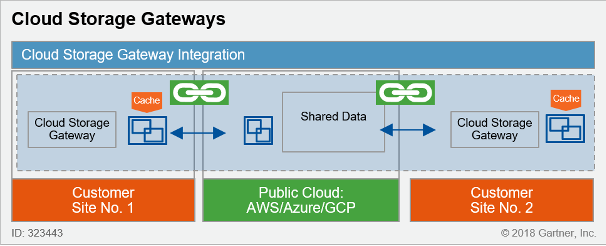
This next approach has been a solution since the early days of public cloud computing. In this scenario, enterprise data centers house gateways deployed as hardware appliances, while files are stored in a centralized repository on the premises or in the cloud.
Source: Gartner (January 2018)[/caption]
This next approach has been a solution since the early days of public cloud computing. In this scenario, enterprise data centers house gateways deployed as hardware appliances, while files are stored in a centralized repository on the premises or in the cloud.
With a cloud storage gateway approach, your data is globally accessible, consistent, and secure. However, you may not always experience optimal performance, and you may face vendor lock-in.
Primary Storage Deployed in Colocation Facilities with Direct Access to Public Cloud
 Source: Gartner (January 2018)[/caption]
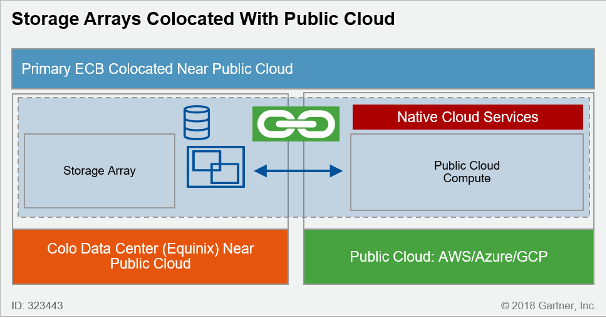
If you’re sharing data between on-premises and public cloud applications, a colocation facility might be the best option. In this solution, these facilities host ECB storage arrays near major IaaS cloud providers, giving you low-latency access to public clouds. With this configuration, you can also migrate between public clouds, because only compute instances are hosted at a specific provider.
Source: Gartner (January 2018)[/caption]
If you’re sharing data between on-premises and public cloud applications, a colocation facility might be the best option. In this solution, these facilities host ECB storage arrays near major IaaS cloud providers, giving you low-latency access to public clouds. With this configuration, you can also migrate between public clouds, because only compute instances are hosted at a specific provider.
Security, easy implementation, and multicloud support are the main benefits of this solution, but it also has major limitations: high cost, loss of end-to-end automation, and low latency.
SDS Solutions That Can Be Deployed and Span Across On Premises and Public Cloud
 Source: Gartner (January 2018)[/caption]
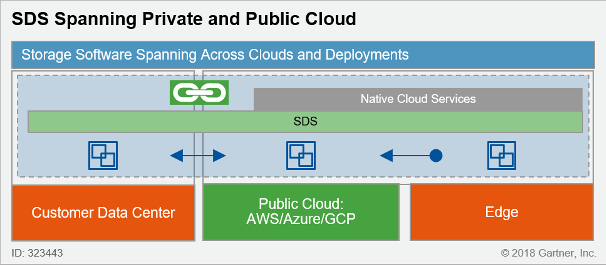
This solution is really two different options. With software-defined storage, you can either bring your own licenses or consume software on demand. In either case, the software in your infrastructure can be deployed in IaaS environments or as a virtual machine, in either a private or a hosted IT environment.
Source: Gartner (January 2018)[/caption]
This solution is really two different options. With software-defined storage, you can either bring your own licenses or consume software on demand. In either case, the software in your infrastructure can be deployed in IaaS environments or as a virtual machine, in either a private or a hosted IT environment.
With SDS, benefits include consistency, flexibility, and a broad set of use cases that fit your solution. However, this configuration can be expensive and complex, especially for persistent workloads. You also have to consider whether or not your SDS products have integration capabilities with other IaaS and PaaS products.
Hybrid Cloud Storage as Part of the Platform
 Source: Gartner (January 2018)[/caption]
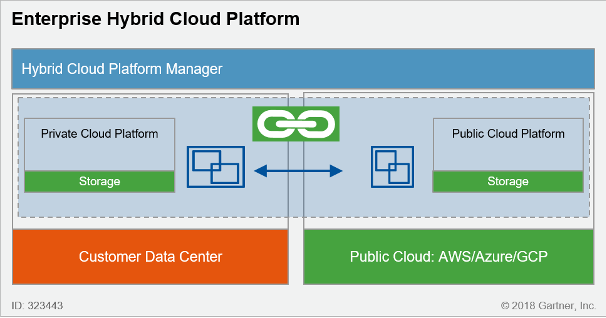
Finally, you might also consider an integrated software-defined data center solution. This scenario offers consistent APIs, tight integration with other IaaS and PaaS services, and a turnkey approach with integrated support.
Source: Gartner (January 2018)[/caption]
Finally, you might also consider an integrated software-defined data center solution. This scenario offers consistent APIs, tight integration with other IaaS and PaaS services, and a turnkey approach with integrated support.
Many OEM and ODM vendors offer this solution, but the upfront investment is costly. It’s also important to keep in mind that in many cases, this solution requires customers to use a single vendor, causing some vendor lock-in.
Choosing the Right Solution
Like Gartner, we believe that your best path forward is the one that works for you and your environment. To learn more about the use cases, benefits, and limitations of each hybrid cloud storage solution, read the full report here.Gartner, Top Five Approaches to Hybrid Cloud Storage — An Analysis of Use Cases, Benefits and Limitations, Refreshed on 9 July 2019