FlexPod VDI Delivers the Standardization and Cloud Connection that VDI Requires

Bruno Messina
 In 1860, the United States had 30,626 miles of train track; by 1900, the number had grown to 193,346 miles. As the nation significantly multiplied its manufacturing capacity, the number of goods and people moving among different parts of the country showed a remarkable increase: railroad freight ton-miles increased 35 times between 1865 and 1915. The railroads scaled commerce and movement of goods and people. However, this increase in connectedness uncovered a new problem: Time was not consistent between cities. The state of Illinois alone had 27 different time zones. Because time was inconsistent, coordinating trains was extraordinarily difficult. The railroads solved the issue with a novel idea called “standard time”. Four time zones were established: Eastern, Central, Mountain, and Pacific. Today, we are extremely familiar with time zone consistency throughout the world. In fact, it is not an overstatement to say that we live our lives using these time zones, considering how often we have to synchronize with other people in personal and professional settings.
A Similarly Expanded View of FlexPod
Just as standard time brought order to time inconsistency, the FlexPod® platform — specifically FlexPod VDI — brings order, synchronicity, scalability, efficiency, reliability, and consolidation to a disorderly virtual desktop infrastructure (VDI) landscape. FlexPod VDI offers benefits in all areas of VDI deployment, including:- Agility and scalability
- Business benefits
- The FlexPod VDI model
- Partners and support
- Availability and efficiency
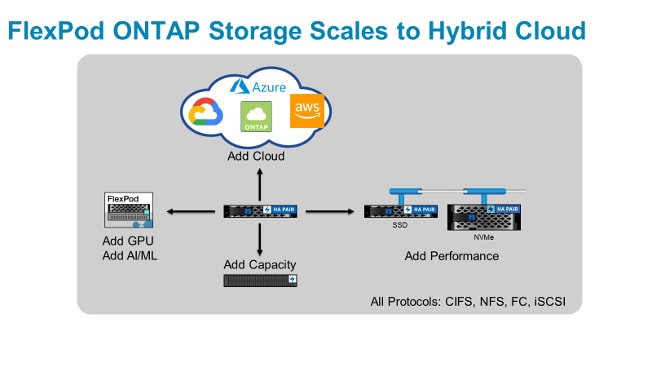 Compared with other converged approaches, FlexPod VDI provides distinctive scaling benefits to VDI users. Through its storage arrays running ONTAP software, FlexPod VDI enables multiple dimensions of VDI scaling:
- If you need more capacity, you can add to your NetApp AFF or FAS system non-disruptively by adding disks or SSDs or even moving to a new NetApp controller/storage system.
- If you need more disks, SSDs, or NVMe drives, you can add disk shelves.
- You can add more public cloud storage as a backup, compliance, tiering, or disaster recovery environment for FlexPod VDI. For example, Azure NetApp Files is an Azure first-party service for migrating and running the most demanding enterprise file workloads in the cloud, including databases, SAP, VDI, and high-performance computing applications. NetApp and Google Cloud have also partnered to offer NetApp Cloud Volumes Service, a fully managed, cloud-native data service that provides advanced data management. In all hyperscalers, FlexPod VDI can backup, cache, tier or DR data as needed. FlexPod VDI comes hybrid cloud ready.
- You can quickly add different workloads, and more of them, with UCS Manager and storage arrays running ONTAP software. This technology allows capacity and workload addition in software, and hardware is added non-disruptively. These features are particularly helpful in adding hardware for spikes or lulls in demand or non-disruptively adding or subtracting workloads beyond VDI.
- You can add more protocols — file and block — on the same array running ONTAP software. This dimension of FlexPod scalability enables FlexPod VDIs to add other block protocols or have block protocols as part of VDI. This level of consolidation
 FlexPod VDI also provides notable business benefits to all workloads. A recent IDC survey of FlexPod customers found numerous benefits that accrued to IT clients of all sizes. These survey benefits are proof from FlexPod customers of its remarkable overall customer appeal and business value, including:
- 65% more time spent on innovation and new projects
- 61% improvement in application performance
- 60% decrease in number of unplanned downtime incidents
- 34% decrease in data center floor space
- 29% reduction in power and cooling
- 24% saved in software capital expenditures (capex)
 Many of these users experienced these and greater benefits with their VDI. And just as the railroad brought advantages to its surrounding communities, FlexPod VDI delivers significant benefit beyond business and technology superiority. FlexPod VDI is distributed through partners with a wellspring of VDI knowledge. Users get cloud-connected benefits through the data fabric powered by NetApp and Cisco CloudCenter management software. VDI and nearly all data center applications can be consolidated on FlexPod because of its enormous scalability. For example, the FlexPod block and file storage protocols can be combined on storage arrays running ONTAP software. This consolidation offers a complete solution for VDI workloads. FlexPod VDI provides dramatic efficiency benefits, because its UCS servers constitute the core of the data center infrastructure for desktop virtualization. UCS drastically reduces the number of servers, switches, network interface cards (NICs), and host bus adapters (HBAs) needed and the amount of cables used per server. Dual-redundant design in all areas of its architecture makes FlexPod VDI reliable. Dual paths, NetApp Snapshot™ copies, and software abstraction enable FlexPod to keep running if any single component, path, server, data, switch, or storage component or controller is lost. In addition, because all components are abstracted in software, any part of the infrastructure can easily be brought back into the design non-disruptively. VDI customers can have not only bulletproof scalability, but scalability with availability.
 FlexPod VDI, like the railroads of the 19th century, can bring order to chaos. If it’s time for you to get scalable VDI in a moment’s notice, consider FlexPod VDI. When you look at your PC’s clock or your iWatch, remember how standard time affects, scales, changes, and synchronizes our lives. And when you look at VDI, remember how FlexPod affects, scales, changes, and synchronizes your VDI applications with exceptional benefits, scalability, and efficiency. Sooner or later it will be time for FlexPod VDI.
For more information, visit:
Bruno Messina
Bruno Messina joined NetApp in 2018 and works in product marketing for FlexPod. His previous experience includes a career in product marketing of UCS servers for Cisco Systems and Solaris server marketing and competitive analysis at both Oracle and Sun Microsystems, where he joined in 2000. Bruno spent ten years in various roles of competitive analysis and product management at Sun Microsystems, leading analysis in both the workgroup and enterprise servers. Prior to Sun Microsystems, Bruno spent time finishing his MBA education and worked for two years at Cadence working on product marketing for both board-level and board timing tools. Bruno holds both a BSEE and MBA from Rensselaer Polytechnic Institute in Troy, N.Y.