NetApp Service Level Manager: Achieve Service Assurance, Performance Guarantee, and Service Optimization

Vishwas V
In this post, let’s look at how NetApp® Service Level Manager (SLM) enables storage consumption based on defined service levels while ensuring service levels and performance guarantees. Think of this as a three-step process:
- Start by standardizing your service levels and defining your service-level objects (SLOs) in your service catalog. With SLM, you can define SLOs for storage capacity and performance. SLM offers significant simplification of storage provisioning according to SLOs.
- Second, apply intelligent provisioning that automatically accelerates service delivery while accounting for the capabilities of the available resources. SLM ensures that utilization and optimization goals are consistently met.
- Finally, SLM monitors the services and establishes a feedback loop to ensure that SLOs are adhered to and consistently met.
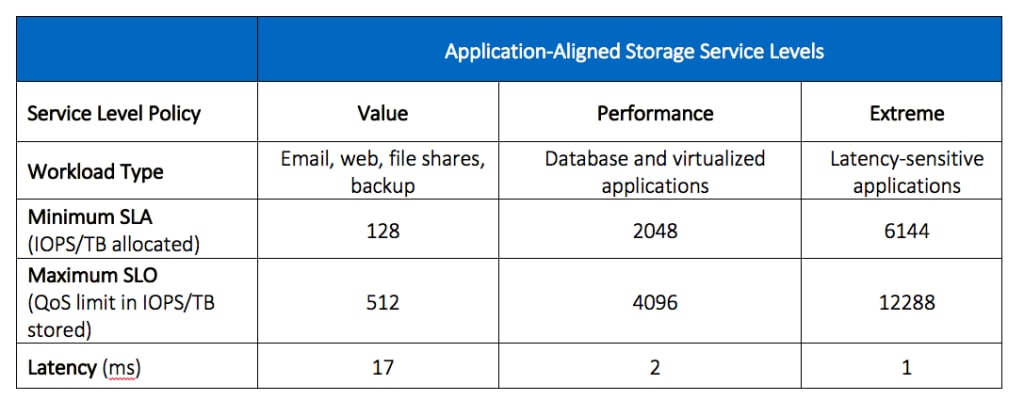 After the workload is onboard, consistent service delivery associated with a service level is guaranteed according to available space, IOPS, and service level assigned. The peak IOPS and expected IOPS are expressed in terms of the amount of I/O that an application requires from its storage. Since an application might need a little—or a lot—of capacity, the SLO policy must be expressed in relative terms that scale according to the amount of storage you are requesting.
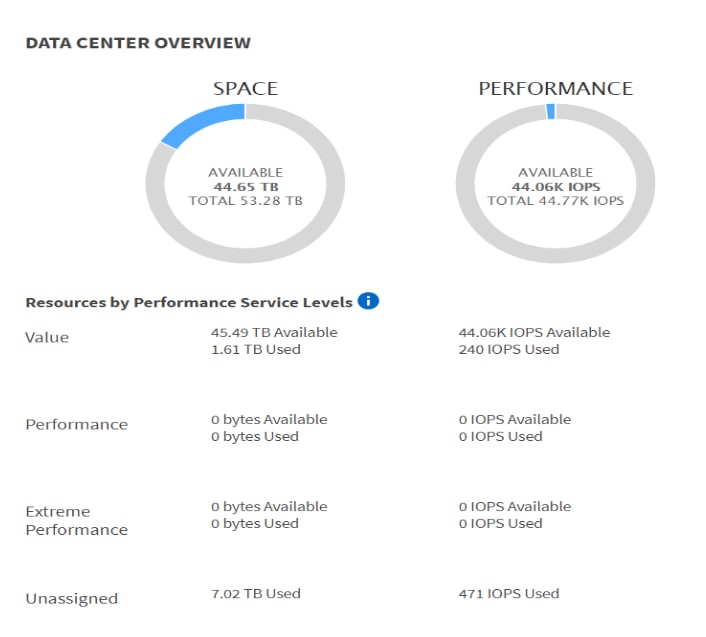
With SLM, regulation is the differentiated key feature. Adjusting the quality of service (QoS) throttle every time the volume size changes or when the used capacity is factored, SLM guarantees the service definitions for the workload.
The conformance monitoring engine keeps track of all relevant workloads and provides an integrated dashboard and reporting scheme for remedial actions.
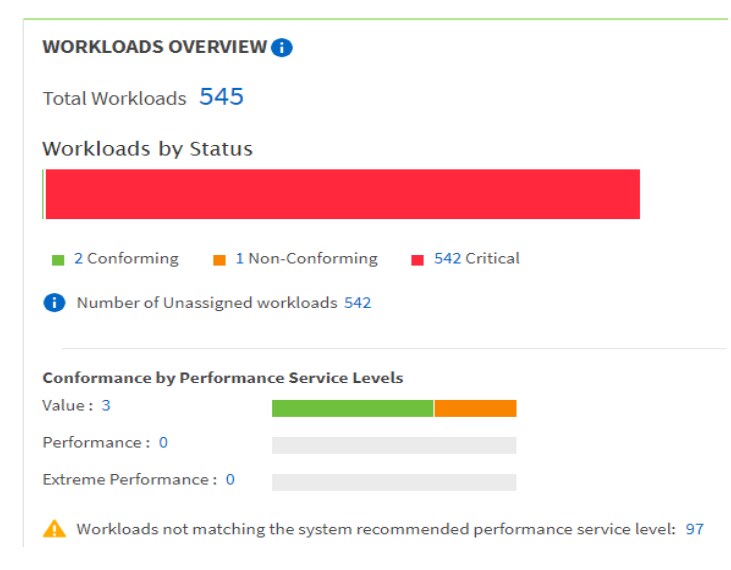 With SLM, the IOPS/TB values are used in several ways:
- Selecting the best storage medium. NetApp SLM uses artificial intelligence and machine learning to analyze the I/O demands and picks the appropriate performance service levels. For workloads that need higher performance, you typically expect a higher number of IOPS per TB of capacity. Therefore, in the default storage service level class definitions described earlier, the Extreme Performance class has a higher number of IOPS/TB than the Value class. SLM uses this value to help ensure that the storage media it selects can meet the needs of the workload.

- Ensuring that each workload gets what it needs … but not more. The peak IOPS/TB value sets a maximum limit for the IOPS delivered to the workload to keep it from consuming more than you intend. This value also keeps the workload from negatively affecting the performance of other workloads running on the same storage. As your capacity grows, that limit will probably also need to grow to provide a consistent experience to your application users. SLM does this by applying this IOPS/TB value to the maximum limit as terabytes are added—for instance, by using the NetApp ONTAP® Auto-Grow feature.
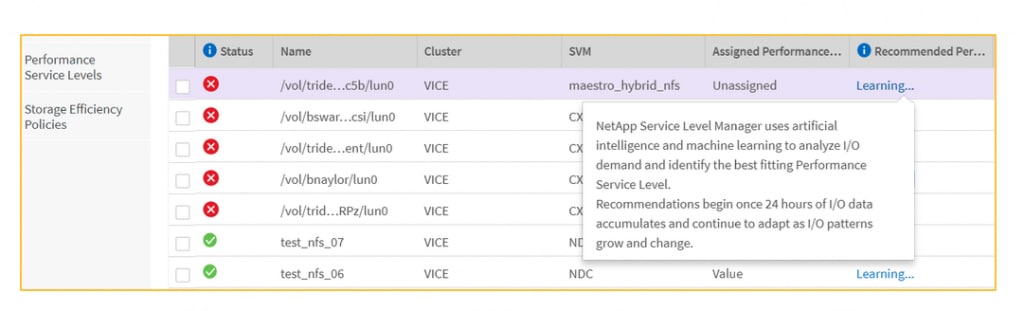
- Determining how many workloads can be consolidated on the same storage. When determining where to provision the requested storage, SLM looks at both the peak IOPS value requested and the expected IOPS value. By looking at these two values together—combined with the value of the maximum limit as capacity used, or terabytes added—SLM can determine the best location for provisioning the storage. This approach ensures that the system can meet all the expected IOPS in both aggregate and peak situations.
NetApp Service Level Manager simplifies storage service delivery and enables you to optimize storage operations for predictable, consistent service. The outcome is a very predictable storage consumption framework providing guaranteed performance and service levels.
NetApp IT has created a series of podcasts that describes the benefits of managing by SLOs. To better understand how you can benefit from SLM, listen to these NetApp Tech ONTAP® podcasts:
- Episode 18: Storage Service Design
- Episode 33: The Return of Storage Service Design
- Episode 36: Storage Service Design—Object Storage
- Episode 49: Data Governance and Operational Point Objectives
Vishwas V
Vishwas is a Manager in Product Management Group for Manageability Products . He is with NetApp for over ten years and has deep understanding of the IT Management, Security and Storage industries. Prior to NetApp, Vishwas has worked with large corporations like Dell EMC, HP to name a few.