NetApp HCI Offers a New 2-Node Storage Cluster for a Starting, Scalable Entry Point for Customer Workloads

Stephen Carl
 NetApp HCI is a compelling solution for modern datacenters by offering independent scaling of compute or storage nodes, Quality of Service for granular application performance control, multi-tenancy for multiple applications to share the same resources, the ability to scale storage and compute resources independently, and advanced data services including replication and protection domains. However, until now the current minimum NetApp HCI configuration has been 2 compute nodes and 4 storage nodes (2+4).
While the minimum configuration is a great solution, our customers and partners have indicated that a configuration with a smaller footprint for NetApp HCI would be even better in a number of use cases such as:
- The location is outside of the primary data center
- The workloads are on the edge of the infrastructure (or IoT)
- The workloads are served at a locally located end point
- The workloads are less dependent on larger configuration resources
- There is limitation on data center physical footprint for new infrastructure
- Cost is a major factor in purchasing enterprise level infrastructure per workload requirements
What’s New: The 2-Node Storage Cluster
The latest release of Element OS 12.0 and NetApp HCI 1.8 provides a smaller solution at a lower entry price. This new minimum configuration is 2 compute nodes plus 2 storage nodes (2+2). By making changes to the configuration of the storage nodes and code changes to Element OS we created a 2-node storage cluster that provides data availability and cluster resiliency while retaining the enterprise features that are expected from NetApp HCI. The below figure shows the 2-node storage cluster architecture.Figure 1) NetApp HCI 2-Node Storage Cluster Architecture
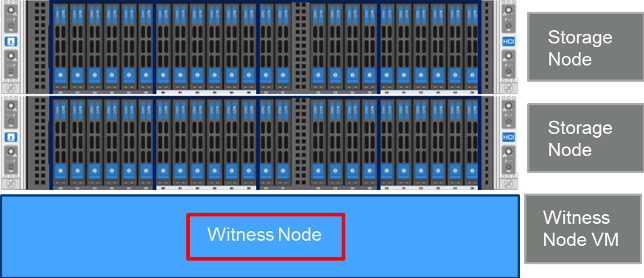 The main configuration change in the architecture is that the two physical storage nodes use an additional node named a witness node in order to maintain cluster health and resiliency. By deploying this witness node, the system meets the minimum requirement of 3 storage nodes to form a cluster quorum. The cluster nodes as members have a voting function to maintain a cluster leader. The witness node is now the third member in the quorum but does not store any data except cluster database information. Why is this important? To handle a physical storage node going offline or failure, the witness node and the remaining physical node promotes a quorum leader, thus eliminating a spit-brain scenario and maintaining consistent data availability and other data services.
Enabling the 2-Node Storage Cluster with Witness Nodes
Witness nodes are simply provisioned as a VMware virtual machine during NetApp HCI installation on any two compute nodes in the HCI configuration. The witness VM is stored on the compute node local drives to enforce the physical separation from the shared Element OS storage cluster of the physical nodes, thus achieving independence and protection of the witness node. This is the primary change in architecture that enables the 2-node storage cluster in the 2+2 HCI solution.Grow and Flex your HCI
The 2+2 HCI deployment can grow and flex as required, with independent scale of compute or storage. If you need more compute resources, simply add more compute nodes. If you need to scale the storage there is flexibility to independently add a 3rd node to enable additional node failure resiliency or add two or more nodes to increase capacity and full Element OS cluster resiliency and advanced data features. While this solution may start as a 2+2, it provides the same scalability features NetApp HCI provides for larger configurations, all the way up to our normal limits of 64 compute and 40 storage nodes per HCI cluster.The smaller NetApp HCI 2+2 solution featuring the 2-node storage cluster is a valuable addition in providing customers more flexibility to design systems to handle business needs with a manageable cost-effective infrastructure solution while providing easy scalability to meet future demands. For more detailed information see the NetApp HCI product page, NetApp HCI documentation resources, and the NetApp HCI 2-node storage cluster technical report.
Stephen Carl
Stephen Carl is a Technical Marketing Engineer for the NetApp Element OS and NetApp HCI products. Stephen has over 20 years of experience in data management and storage product related roles. Stephen works with product management, engineering, product marketing, and the field helping to provide content to help customers better understand products and their capabilities to solve business requirements.