How live broadcast editing runs on all-flash storage
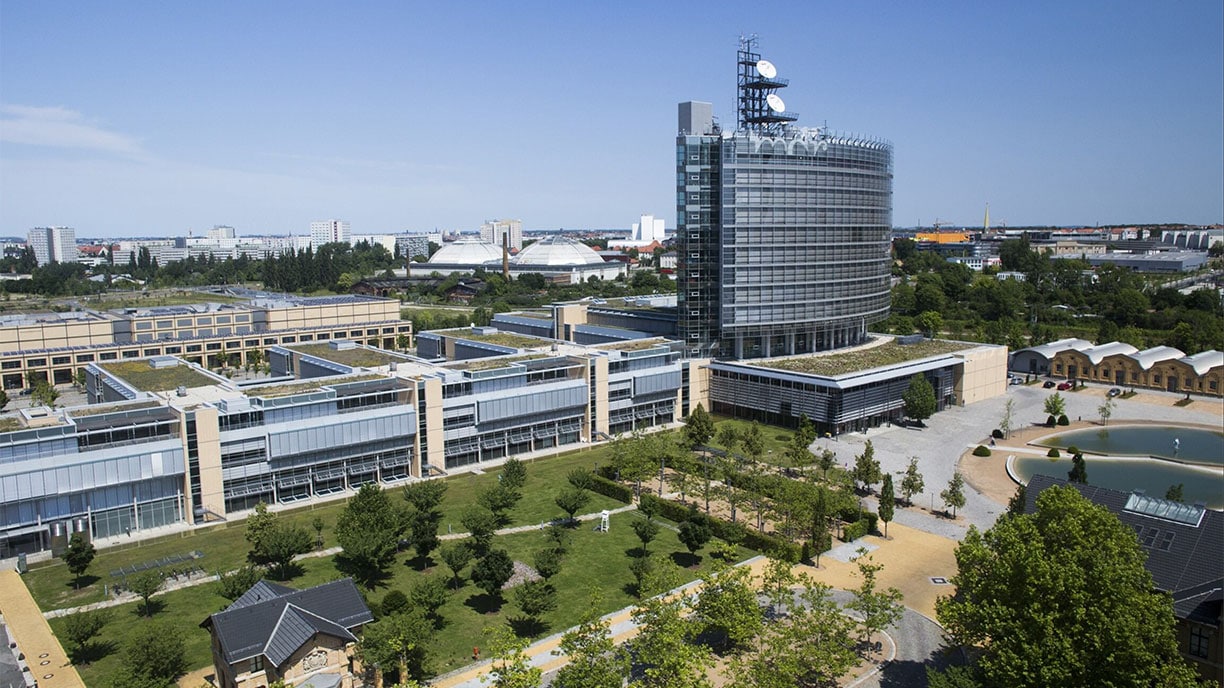
Image Copyright: MDR/Stephan Flad

Why regional broadcasters live or die on fast shared storage
The whistle blows for halftime. Somewhere in the stands, a fan pulls out a phone, ready for the highlights. Not tonight. Not tomorrow. Now, while the second half is minutes away and the recording is still running in the stadium.
For Mitteldeutscher Rundfunk (MDR), that's not a stretch goal. That's the job.
Loyal regional soccer fans tune in for a first overview of the highlights during the halftime break, on their favorite clubs, from matches still in play. Delivering it isn't glamorous. It's a demanding, a repeatable operational expectation, and it lands squarely on the storage.
Here's why. Video material must be available on a storage system almost the instant it's recorded. That's the only way multiple editing systems reach the same footage at the same moment, which is the only way editors process content immediately and report up to the minute. No waiting. No queue. No excuses when the clock is running.
And soccer is only the visible part. Champions League level editing software doesn't run on hobby-grade storage. Only when both work in harmony can editors cut quickly and without stress, even mid-broadcast.
Many viewers are amazed and thrilled because they often only find out through us what great things are happening right around their corner.
Torsten Hoffmann, Project Manager and Planning Engineer for Media Production, MDR
The load hits all at once. Multiple editors. Simultaneous access to the same files. Background copying inside the content management system (CMS). Every bit of it under pressure, every second on deadline.
How MDR proved the storage could keep up under real production load
MDR didn't take performance on faith. Together with NetApp and NetApp partner Computacenter, the team built a proof of concept around the real demands of audio and video processing. Load generators and four editors simulated simultaneous editing across a large number of workstations, with CMS background copying running in parallel.
The verdict was clear. NetApp met the requirements of standard HD production in full, and the work ran smoothly for the people doing it. Early UHD tests looked promising too.
Then the team pushed further, into the scenario nobody wants to gamble on live: breaking news fed straight from the editing workstation.
That is not our standard path, but we tried it, and it works. Then NetApp broadcasts live, so to speak.
Torsten Hoffmann, Project Manager and Planning Engineer for Media Production, MDR
To validate the systems the right way, MDR ran storage overload tests and scaling measurements alongside ARGE Rundfunk Betriebstechnik (RBT), a technical working group for standardized testing, acceptance, and measurement procedures across public broadcasters. The scenarios were deliberate: verify bandwidths, latencies, and stability under realistic production loads.
Under laboratory conditions, the selected NetApp system, in the hardware and software provided, proved suitable for MDR's applications. It delivers a highly available, fail-safe storage foundation with very high throughput to the editing clients.
One line from the tests says more than any spec sheet:
In the proof-of-concept test, our video editors felt like the material was located locally on their own machine.
Sven Letzel, IT Infrastructure Planning and Deployment, MDR
That's the goal in a sentence. Footage sitting on a shared central system. Editors feeling like it's on their own desk. Both true at once. That's precisely what mid-broadcast editing demands, and it's exactly what fails first on slower storage.
What stable, high-throughput storage delivers day to day
Today, MDR editors regularly cut selected productions on an Adobe Premiere workstation connected to NetApp storage. Their verdict is refreshingly plain: it holds up. Stable, high-performance, stress-free editing operations, even under heavy load.
The rollout keeps moving. MDR will retrofit all editing workstations to the productive NetApp storage environment over the course of 2026.
Here's what the broadcaster gained:
- A fail-safe, highly available foundation that keeps editors cutting during live broadcasts
- Very high throughput to editing clients, so shared footage feels local
- Simultaneous multi-editor access with CMS background copying, and no delays
- Proven headroom for HD today and UHD next
- A single, manageable set of systems that fits the existing landscape
Where MDR goes next: cost discipline, AI, and shared lessons
Investment and operating cost management matter here, and MDR treats them that way. The goal is to make the fullest functional and capacity use of a manageable number of systems, run economically, and avoid sprawl.
NetApp storage for Adobe Premiere editing meets those requirements at an attractive price and fits the existing system landscape. That fit opens doors. MDR is already weighing NetApp for file services in media production, as graphics storage, and for radio data. Hoffmann also expects NetApp systems to handle what's coming next, including AI-assisted video editing.
And the lessons won't stay in-house. Sven Letzel from MDR IT Infrastructure Planning wants other media companies to learn from the proof of concept.
NetApp has always reacted quickly to new requirements and supported us well.
Sven Letzel, IT Infrastructure Planning and Deployment, MDR
The NetApp systems behind MDR's editing workflow:
- NetApp AFF A250 (2 units): The entry-level all-flash system for consolidating workloads, used for server virtualization.
- NetApp FAS 2820, FAS 8300, and FAS 50: Three FAS systems clustered in a separate fire compartment, serving as backup storage and an emergency system for the production storage. Data is replicated using NetApp SnapMirror replication technology.
- NetApp AFF C250, NetApp AFF C60 (2 units), and NetApp StorageGRID SG5712: The StorageGRID appliance automatically moves older office data of roughly 500TB into object storage, while about 60TB of current data stays online on the flash storage of the AFF C250. The capacity-optimized all-flash storage of the NetApp AFF C60, each with 250TB of usable storage, is used exclusively for video editing with Adobe Premiere.
- NetApp ONTAP Select: Two instances of this software-only version of ONTAP provide persistent storage for various Kubernetes clusters.
See the future
Maximize your advantage by maximizing your data.


