Creating life-saving treatments with AI

分享本頁

Gabie Boko
According to Forbes, AI is expected to see an annual growth rate of 36.6% from 2023 to 2030. Additionally, 72% of businesses have adopted AI for at least one business function.
But what about using data and AI to accelerate drug discovery? Yes, it’s real, and yes, it’s already happening.
Would it surprise you to learn that an estimated 80 percent of pharmaceutical and life sciences professionals say they’re already using AI for drug discovery? That’s according to industry research by Scilife. The company also estimates that by the end of 2025, AI is projected to create as much as $410 billion in annual value for the pharmaceutical industry.
I recently sat for a conversation with one of the industry’s leading data science visionaries, Monica Jain, director of R&D data science for Johnson & Johnson. She graciously agreed to share her insights with me during an on-camera interview at NetApp INSIGHT 2024. Monica’s thought-provoking perspectives around AI’s central role in drug discovery have been consolidated into a five-minute highlight reel.
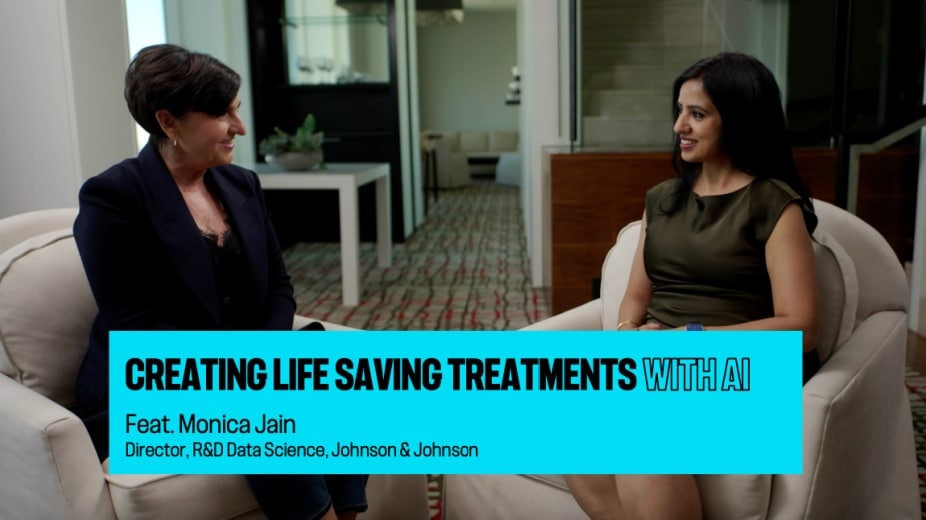
Here are four key points that Monica made during our conversation, and they completely shifted my perspective on the unlimited use cases of AI.
AI is changing how pharmaceutical leaders spend their time
Traditionally, pharmaceutical leaders have spent much of their time immersed in data, working to analyze it, making sense of what it means, and deciding what their next steps should be based on it. Monica astutely pointed out that at Johnson and Johnson, AI is already handling the data analysis portions of pharmaceutical leaders’ jobs—specifically, converting unstructured data into structured data and then summarizing what the data reveals. That means decision-makers can spend their time and attention evaluating more educated, data-based actions.
AI brings thousands of minds together for drug discovery
The drug discovery process has traditionally consisted of just a few scientists poring over copious amounts of data—such as thousands of patient images and videos—and then tapping into their experience and expertise to make sense of what the data are telling them…which is a lengthy process to say the least. Monica observed that AI increases the number of scientists working on a drug from a few to “thousands of minds.” Truly, it’s an awe-inspiring way to view the role of AI in drug discovery. It also allows scientists to save their valuable time and energy and instead pour even more into their patients, further improving outcomes, which is spectacular.
AI requires a data enablement mindset
Earlier in her career, Monica says she was trained to be a consumer of data. But about five years ago, she had an epiphany: Instead of viewing her role as a data consumer, she realized that she needed to reposition herself as a data enabler—that is, someone who proactively brings all the right high-quality data to the table so that this data can be used effectively in modeling. With the rise of AI, the distinction between data consumer vs. data enabler has become even more important. Those who will lead the AI revolution will need to be data enablers, not data consumers.
AI will transform how patients interact with their healthcare data.
Patients have historically relied on their healthcare providers and their own research abilities to understand and interpret their personal health information. However, there’s no easy or standardized way to predict one’s long-term disease risks or trends based on vital signs, so these insights are not being used reliably in healthcare decision-making. Monica believes AI will enable patients to receive quantified, personalized information about their long-term healthcare trends and risks, so patients can make informed decisions today that could change the course of their long-term healthcare trajectory.
Talking to Monica was one of the top highlights of NetApp INSIGHT 2024 for me. I’ll never think about AI’s role in the pharmaceutical industry the same way again, and I hope you find our conversation to be equally as perspective altering.
Gabie Boko
.png?width=5760&format=avif&disable=upscale)