Enterprise Agreement Express Terms
Capitalized terms have the meaning given to them in NetApp's Terms with Customers, unless otherwise noted. In the event of any inconsistencies between the terms of these EA Express Terms and the General Terms and Software Terms, the terms of these EA Express Terms prevail.
- Definitions:
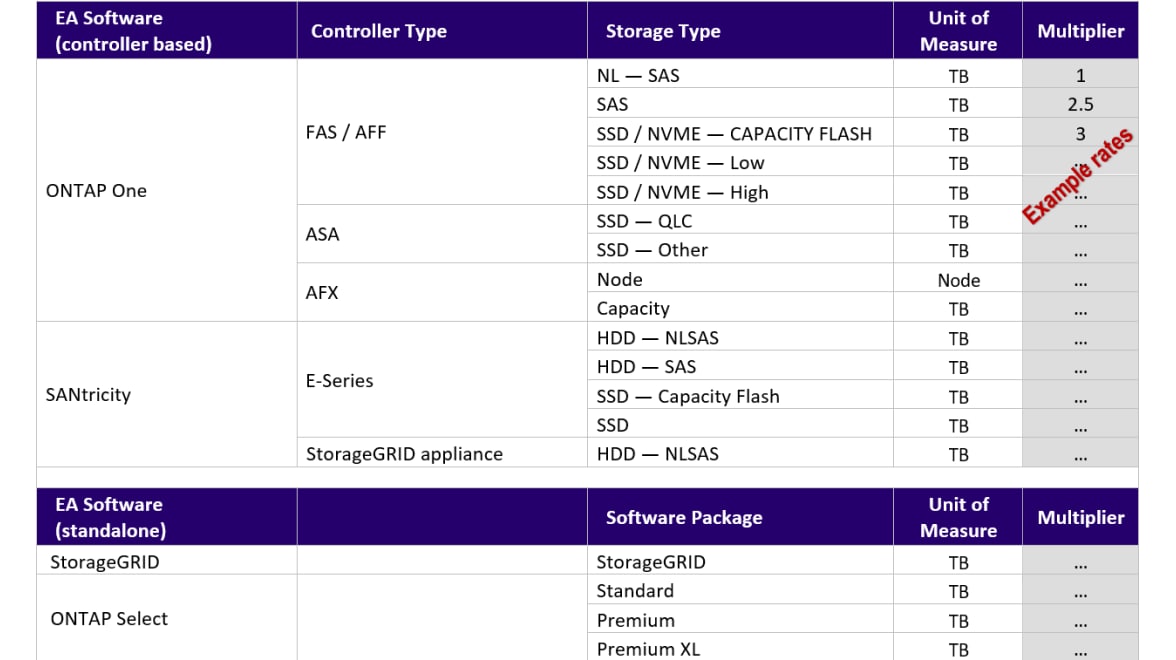
- "Controller" means the Hardware related to the EA Software described in Exhibit A, Table 1.
- “EA Software” means the Software set forth in ordering document between Partner and Customer.
- “EA Term” means the term of the Enterprise Agreement Express, as set forth on an ordering document between Partner and Customer.
- “Fees” means the amounts that Customer will pay to Partner for the EA Software.
- “Territory” means the geographic region identified in an ordering document where EA Software may be installed and used.
- LICENSE GRANT AND RESTRICTIONS.
- License Grant. Subject to Customer’s payment of the applicable Fees to Partner and NetApp's receipt of a corresponding Purchase Order, NetApp grants to Customer a personal, nonexclusive, nontransferable, worldwide, limited and revocable license, without the right to sublicense, to a) install and use the EA Software on either a standalone basis, as applicable, or on Controllers that Customer purchases or leases during the EA Term, up to the Total Cap (as defined in Exhibit A); b) use the EA Software for Customer’s internal business, and c) use the related Documentation in support of Customer’s use of the EA Software.
- Controller-Based Licenses. EA Software for use with Controllers consists of controller-based licenses identified by a unique serial number, and such EA Software is licensed for the period of time during which Customer’s storage controller is operable. Each storage controller deployed in a cluster or a high-availability pair or group must have the same controller-based licenses as the other storage controllers in that cluster. Subject to notice by Customer to NetApp, and in the context of non-disruptive operations within a cluster, Customer may deploy storage controllers with different controller-based licenses and failover from one storage controller to another for the time required to remedy a failure, provided that all storage controllers in the cluster have the same level of Support Services in effect at all times.
- Unauthorized Use. Use of the EA Software outside of the scope of the applicable license terms constitutes a material breach.
- Acquisition and Divestiture. If during the EA Term, Customer acquires a third party or is acquired by a third party, such acquiring or acquired entity is deemed out of scope under the Agreement unless otherwise agreed to in writing by the parties. If Customer divests a portion of its business, the divested entity will not be entitled to continue receiving EA Software under the Enterprise Agreement Express.
- Acquisition by NetApp of New Software Products. Any new Software that NetApp may offer as a result of an acquisition or merger with another entity during the EA Term are excluded from this EA and will not be offered as EA Software, unless otherwise agreed by the parties in writing.
- Reporting. NetApp will provide reporting to Customer when Customer has used 50%, 75% and 100% of its Initial Capacity and Additional Capacity (as applicable).
- Effect of Termination / Expiration. Customer's right to order EA Software under these EA Express Terms will end at expiration of the EA Term, unless the EA Express Terms are otherwise earlier terminated ("Expiration Date"). Upon the Expiration Date, NetApp grants to Customer the right to install and use EA Software to the extent such EA Software was ordered by Customer, and such corresponding Purchase Orders were accepted by NetApp, before the Expiration Date.
- Effect of EA Express. This Agreement constitutes the entire agreement between the parties and supersedes and replaces all prior agreements, whether written or oral, relating to the EA Software. In no event will any terms between the parties regarding acceptance, pricing, refunds, or remedies for service level non-compliance that include compensation or credits apply to this EA Express Terms. Except as expressly amended by these EA Express Terms, all other terms and provisions of the General Terms and Software Terms remain in full force and effect.
EXHIBIT A
CAPACITY
- Definitions.
- “Capacity Unit” means the unit of measurement that is calculated in accordance with the formula below, and which represents the quantities of EA Software licenses that Customer is entitled to receive during the EA Term.
Formula: Unit of Measure of specific Storage Type/Software Package acquired by Customer * Multiplier = Capacity Units - “Multiplier” means the conversion rate assigned by NetApp used to determine the total number of Capacity Units, by specific Storage Type/Software Package, that Customer is entitled to receive during the EA Term.
- “Storage Type/Software Package” means the storage media or software package applicable to the EA Software.
- “Capacity Unit” means the unit of measurement that is calculated in accordance with the formula below, and which represents the quantities of EA Software licenses that Customer is entitled to receive during the EA Term.
Exhibit A, Table 1
EA Software
- Measuring the Cap Balance.
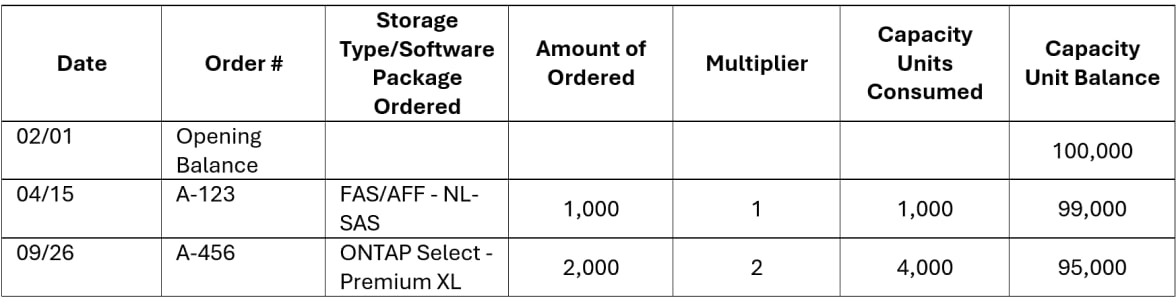
During the EA Term, Customer is entitled to install and use EA Software licenses up to the total number of Capacity Units purchased during the EA Term (Customer's Initial Capacity as set forth on Customer's EA Express Order Form with the applicable NetApp Partner, in addition to any additional Capacity Units purchased in accordance with Section 3 below). Set forth below in Table 2 is an example of how Customer’s entitlement to EA Software will be reduced against Customer's Capacity Unit balance.
Exhibit A, Table 2
Example - Capacity Unit Balance
- Customer’s Rights Upon Using All Initial Capacity.
- During the EA Term, if Customer uses all of its Initial Capacity, then Customer may purchase additional Capacity Units (“Additional Capacity”) directly from a Partner, subject to the purchase requirements set forth below. To purchase Additional Capacity, Customer will provide written notice to the Partner, who will issue a quote to Customer for the Additional Capacity fees.
- Additional Capacity Purchase Requirements:
- Minimum Purchase Tranche: Additional Capacity is available for purchase in minimum tranches of 10% of the Capacity Units initially purchased. NetApp will offer the same price per Capacity Unit as the initial purchase.
- Example: If the total initial purchase was 100,000 Capacity Units, the minimum additional capacity tranche available for purchase would be 10,000 Capacity Units.
- Unlimited Tranches: There is no limit to the number of additional capacity tranches that Customer may purchase during the EA Term.
- Non-Reimbursable Unused Balances: Any unused additional capacity tranche balances at the end of the EA Term are non-reimbursable from NetApp.
- Minimum Purchase Tranche: Additional Capacity is available for purchase in minimum tranches of 10% of the Capacity Units initially purchased. NetApp will offer the same price per Capacity Unit as the initial purchase.
- During the EA Term, if Customer uses all of its Initial Capacity, and does not exercise its option to purchase Additional Capacity, then Customer will receive a license to the EA Software up to the Initial Capacity.
- If Customer purchases Additional Capacity, Customer’s usage will be measured in the same manner as the Initial Capacity.
.png?width=5760&format=avif&disable=upscale)