Introducing OCI NetApp Storage Service
Native ONTAP Storage on OCI

Compartilhar esta página

Pravjit Tiwana
Organizations are accelerating their move to the cloud, and while rock-solid availability and high performance remains a top priority for enterprise workloads, it is not the only hurdle. The true challenge lies in leveraging their extensive amount of data, finding a way to preserve the robust data infrastructure capabilities and operational consistency they have come to rely on in their on-premises environments.
To address this need, Oracle and NetApp are expanding their partnership across Oracle data platforms and enterprise infrastructure with Oracle Cloud Infrastructure NetApp Storage Service, a first-party storage service that brings NetApp intelligent data infrastructure natively to Oracle Cloud Infrastructure (OCI). The service combines the strengths of both companies: OCI’s secure, high-performance cloud infrastructure together with NetApp ONTAP’s industry-proven data infrastructure capabilities for enterprise file, block, and object workloads, all with integrated procurement and support from Oracle.
For customers standardized on NetApp, OCI NetApp Storage Service brings the familiar ONTAP operating model to OCI, with capabilities including multiprotocol access, near-instantaneous snapshots and clones, storage-native replication, application-consistent data protection, cold data tiering, WORM retention, and hybrid or multicloud data mobility through a unified data fabric. These capabilities support enterprise requirements for workload migration without refactoring, disaster recovery, data protection, compliance, hybrid cloud operations, and multicloud deployments. All of these capabilities can be brought to bear across a wide range of workloads, including AI & Analytics, Database, Electronic Design Automation (EDA), VMware.
OCI NetApp Storage Service extends the OCI storage suite, which already includes Oracle Cloud Infrastructure Block Volume, Oracle Cloud Infrastructure File Storage, Oracle Cloud Infrastructure Object Storage, and Oracle Cloud Infrastructure File Storage with Lustre, with a first-party ONTAP-based service for customers that want to preserve familiar storage operations, data protection policies, and disaster recovery workflows as they move to OCI. This makes the service especially relevant for enterprise application migration, regulated environments, hybrid cloud, multicloud, and disaster recovery initiatives.
Why this partnership matters for customers
OCI has built a strong reputation around price-performance, distributed cloud reach, security, and enterprise SLAs. OCI offers end-to-end SLAs for availability, manageability, and performance; globally consistent pricing; broad public cloud region coverage; and compliance coverage for global, regional, and industry standards, including SOC, PCI DSS, HIPAA, HITRUST, and GDPR. OCI also emphasizes lower foundational service costs compared to other hyperscalers, including compute, block storage, and networking.
A first-party NetApp service complements this foundation rather than replacing it. OCI File Storage provides enterprise-grade NFS capabilities, OCI Block Volume enables independent tuning of performance and capacity, OCI Object Storage delivers durable, regional object storage with private VCN access through service gateways, and OCI File Storage with Lustre supports high-performance file storage for demanding AI, ML, HPC, and simulation workloads. Now customers who value the ONTAP operating model with rich multi-protocol support and storage-native data services can support all of these different file, block, and object capabilities within OCI without rearchitecting applications or changing established data management practices.
This is especially important for enterprises that rely on NetApp capabilities such as snapshots, FlexClones, SnapMirror, SnapCenter, SnapLock, FabricPool, FlexCache, and multiprotocol NAS and SAN architectures. ONTAP offers a unified storage operating system for hybrid cloud environments, with built-in QoS, automatic tiering, and integrated security features, including autonomous ransomware protection. NetApp’s strategy of deep integration with major cloud providers makes OCI a natural extension for enterprise-grade, first-party storage capabilities.
Together, OCI and NetApp give enterprises a practical path to modernize on Oracle Cloud while preserving familiar storage operations, data protection policies, disaster recovery workflows, and hybrid cloud practices.
What the service is designed to deliver
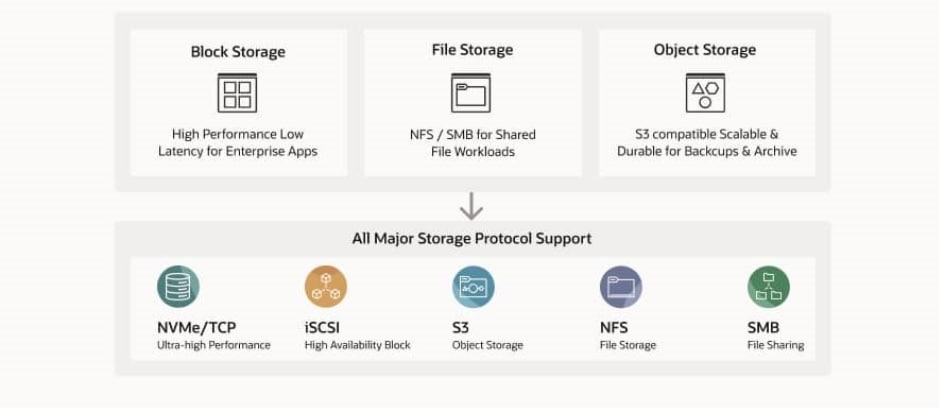
At the feature level, OCI NetApp Storage Service is designed to bring the core ONTAP capability set to OCI through a first-party service model. ONTAP supports major industry-standard protocols, including NFS, SMB, NVMe/TCP, iSCSI, and S3, with enhancements such as pNFS for parallel access. ONTAP snapshots and clones are near instantaneous and space-efficient; they enable customers to create backup, recovery, test/dev, and analytics environments in seconds while minimizing storage overhead and reducing operational disruption. SnapMirror helps customers simplify disaster recovery by replicating both data and storage configurations, enabling faster failover with less manual reconfiguration. FlexCache allows customers to leverage data in on-premises data centers, OCI, and/or other clouds to build a global namespace that’s accessible anywhere needed, without any up-front data migration.
Cloud parity is an important consideration for customers evaluating enterprise storage services across environments. OCI NetApp Storage Service is designed to bring industry proven ONTAP-based data infrastructure into OCI, with specific service packaging and availability defined by the OCI service model.
Security and compliance are key enterprise mandates to adopt cloud technologies. With OCI NetApp Storage Service, customers have the flexibility to encrypt data at rest, while SnapLock enables WORM retention aligned with regulations such as SEC 17a-4, HIPAA, FINRA, CFTC, and GDPR. Autonomous Ransomware Protection built directly into ONTAP adds threat detection for NAS and SAN environments. For regulated industries, these features provide critical controls for retention, recovery, and auditability.
Together, these capabilities help customers address critical enterprise requirements for large-scale workload migration, disaster recovery, hybrid cloud operations, multicloud data mobility, compliance, and cyber resilience.
Why OCI amplifies the NetApp value
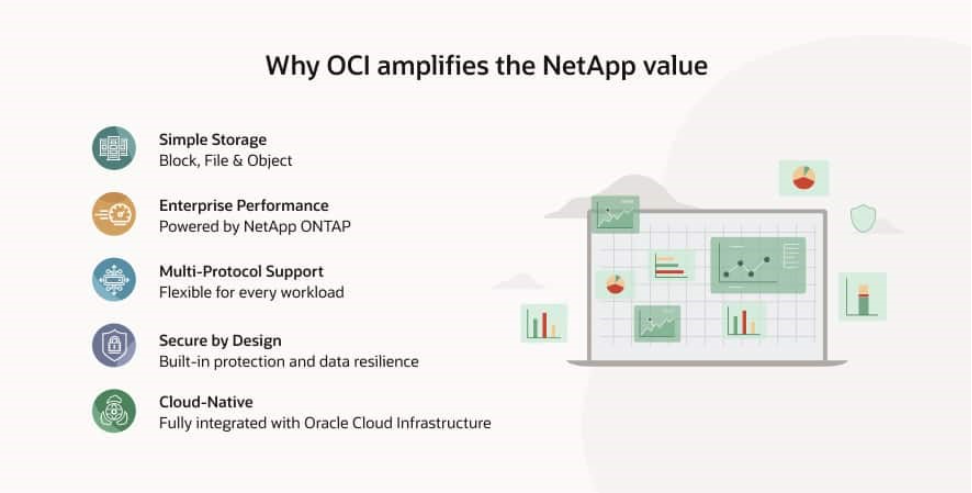
By combining NetApp ONTAP with Oracle Cloud Infrastructure (OCI), customers gain a cloud platform that delivers higher performance, simplified operations, stronger resilience, and better economics for enterprise workloads.
Accelerate performance for demanding workloads: Customers can run performance-sensitive applications with confidence using OCI's high-performance compute, networking, and storage infrastructure. Whether supporting databases, AI/ML, analytics, or enterprise applications, OCI provides the low latency, high throughput, and scalability needed to maximize the value of NetApp-powered storage.
Seamlessly connect and protect data across environments: OCI enables secure, high-speed connectivity between on-premises data centers, OCI, and other cloud environments. Combined with NetApp SnapMirror replication and FlexCache integrated caching, customers can move, synchronize, cache, and protect data efficiently while maintaining enterprise-grade security and private network access.
Simplify business continuity and disaster recovery: Customers can build resilient architectures that span availability domains, fault domains, and regions to meet stringent availability and recovery objectives. OCI Full Stack Disaster Recovery integrates with NetApp replication capabilities to automate recovery processes, helping reduce downtime and operational complexity.
Optimize costs without compromising performance: OCI's predictable pricing model, efficient networking, and elastic infrastructure help customers control cloud costs while scaling as needed. When combined with NetApp's storage efficiency technologies—including compression, deduplication, snapshots, and intelligent tiering—organizations can lower overall infrastructure and data management costs while maximizing resource utilization.
How customers realize the most value
Accelerate Cloud adoption with minimal disruption: Organizations can move enterprise applications to OCI faster and with less risk by preserving existing storage access methods and application architectures. This reduces the need for costly application refactoring, shortens migration timelines, and helps maintain business continuity throughout the transition to the cloud.
Strengthen business resilience and recovery: Customers can reduce downtime and improve operational continuity with integrated data protection and disaster recovery capabilities. Automated replication and coordinated recovery workflows help ensure critical applications remain available and recover quickly in the event of outages, cyber incidents, or regional disruptions.
Simplify hybrid and multicloud operations: Organizations can manage and protect data consistently across on-premises environments, OCI, and other cloud providers. This enables greater flexibility in workload placement, simplifies governance and compliance, and allows teams to operate with a unified data management strategy regardless of where applications run.
Scale on demand to meet dynamic business needs: Customers can rapidly expand compute resources when demand spikes without having to replicate large datasets or redesign applications. By bringing data closer to cloud resources, organizations can accelerate project deployment, support distributed teams, and respond more quickly to changing business requirements while controlling infrastructure costs.
Workloads that benefit most
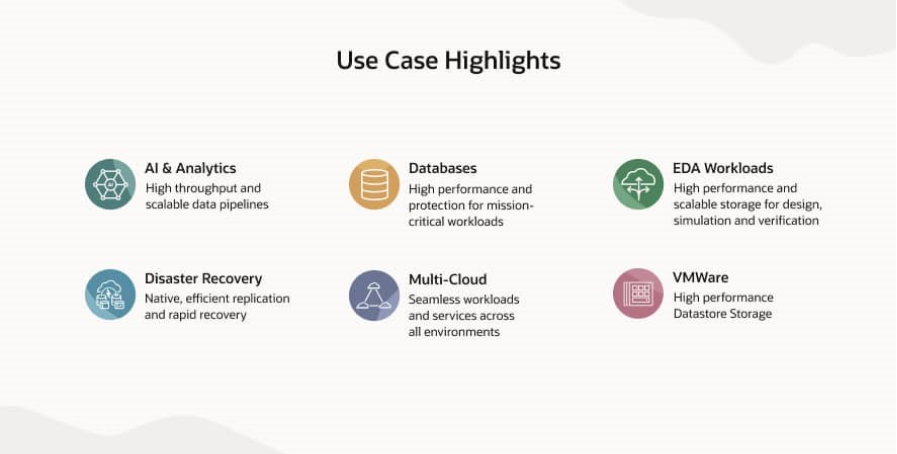
Electronic Design Automation (EDA): EDA workloads benefit from high-performance compute, scalable file systems, and high-throughput networking. NetApp FlexGroup volumes are well suited for metadata-intensive workloads, with benchmarks showing significant improvements in performance and concurrency. NetApp FlexCache volumes deliver high-performance access to customers’ on-premises data.
Oracle Database and applications: NetApp supports high availability, faster backups, and improved operational efficiency. SnapCenter provides centralized, application-consistent protection across environments, helping customers protect Oracle databases and enterprise applications with familiar NetApp workflows. FlexClones assist customers to run test and dev workloads on operational databases without impacting the performance of primary volumes.
Oracle Cloud VMware Solution (OCVS): OCI currently supports Block, File, and Object Storage for OCVS. OCI Storage with NetApp can enhance guest workload storage patterns and adjacent enterprise data services. Support as a certified datastore is expected at GA.
Analytics, AI, and test/dev environments: Snapshots, writable clones, integrated caching, and data mobility capabilities can help teams rapidly create development, testing, analytics, or validation environments using production-like data while reducing unnecessary data duplication.
Regulated industries: The public sector, financial services, and healthcare benefit from strong data protection, retention, and compliance capabilities. NetApp and OCI together provide a robust foundation for these requirements.
Conclusion
OCI Storage with NetApp represents more than another storage option in OCI. It provides enterprises with a familiar ONTAP operating model delivered through Oracle's cloud infrastructure and support framework, helping customers move and modernize workloads while preserving established storage operations, data protection policies, and DR workflows.
Organizations should prioritize workloads that benefit most from protocol continuity and storage-native services, such as EDA, Oracle databases, VMware workloads, regulated applications, hybrid cloud, and DR. At the outset, customers should design architectures around FastConnect dedicated private connections to their enterprise data centers, leveraging SnapMirror and FlexCache across two or more regions to get the greatest value from OCI Storage with NetApp.
Learn more
For more information, check out the Oracle Cloud Infrastructure NetApp Storage Service page.
This blog was co-authored by Sid Padgaonkar, Sr. Director – Oracle Product Management (Gen AI) - Strategic Customers
Pravjit Tiwana
Pravjit Tiwana is NetApp’s Senior Vice President and General Manager for Cloud Storage and Services. In his role, Pravjit is responsible for continuing the acceleration of our market leading first-party services in all three public clouds.
He is a technology executive with over 25 years of experience in building highly scaled cloud powered products, services and businesses. At NetApp, he is responsible for accelerating NetApp’s Cloud Storage business across top hyperscalers including Azure, AWS, GCP, OCI and Neocloud.
Próximas etapas
.png?width=5760&format=avif&disable=upscale)